

ICS and Beijing News Jointly Release "Report on International Dual-Center Consumer Cities"
ICS and Beijing News Jointly Release "Report on International Dual-Center Consumer Cities"
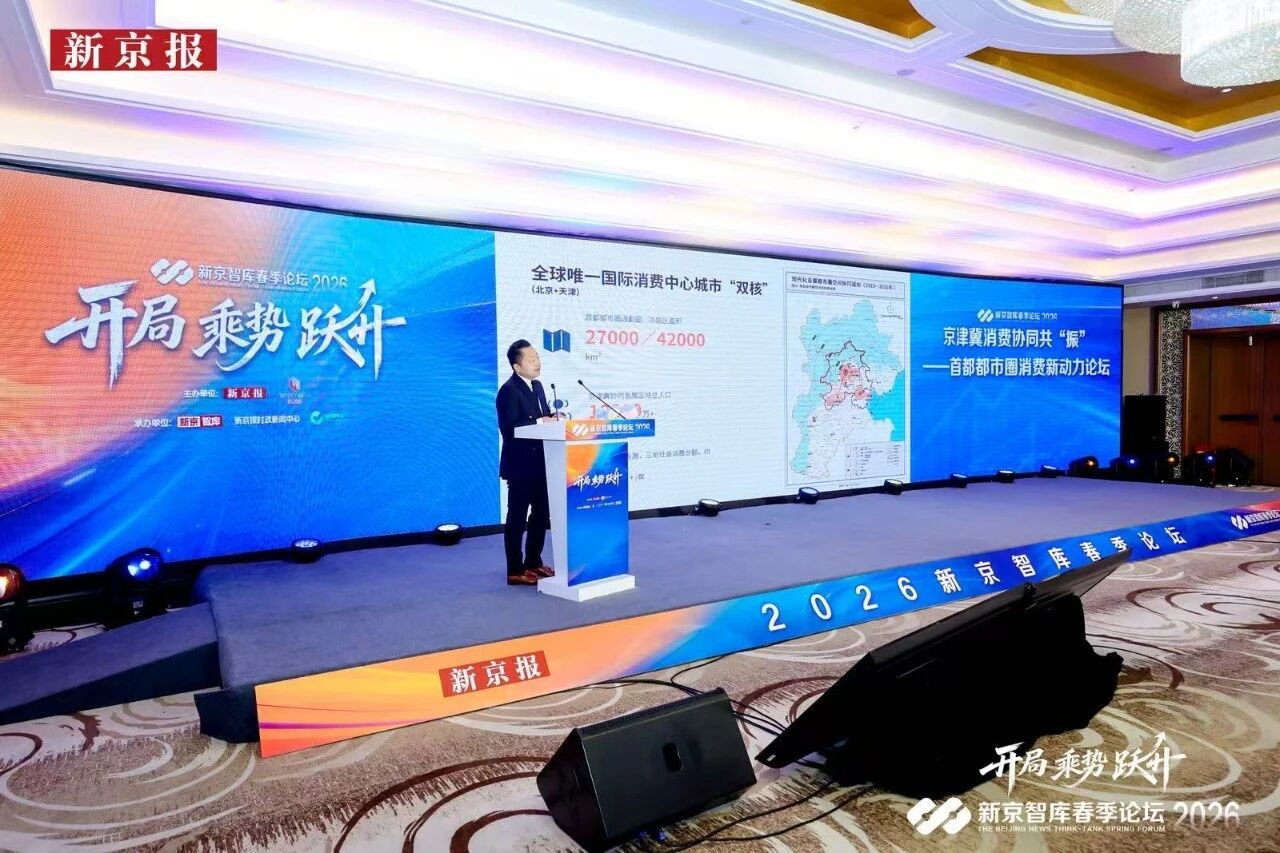
On April 25, Qin Gang, Director-General of the International Center City Strategic Development&Cooperation Center (ICS) and Senior Research Fellow at the World Information Institute of the State Information Center, released the "Research Report on the Collaborative Construction of the Capital Metropolitan Area's International Consumption 'Dual-Center' Cities through Beijing-Tianjin-Hebei Integration."
The report, jointly conducted and released by ICS and the Beijing News Think Tank, invited experts from ten international cities to participate. It proposes a "dual-core leadership, three-region collaboration" model to promote Beijing and Tianjin in building the world's only international consumption "dual-center" cities.
The report demonstrates the foundation, advantages, and strategy of the Beijing-Tianjin international consumption dual center in the capital metropolitan area from six dimensions:
1. Empowerment by the Capital's "Four Centers" Positioning:
The political, cultural, international exchange, and science & technology innovation centers provide institutional, content, traffic, and scenario support for consumption.
2. Beijing's Diverse International Scenarios:
The clustering of embassies in Chaoyang District, combined with Zhongguancun, CBD, and the Beijing Municipal Sub-Center, collaboratively constructs new scenarios for international business consumption.
3. Complementarity and Sharing Between Beijing and Tianjin:
Beijing's modern civilized urban landscape and Tianjin's international architectural clusters and port resources create a consumption appeal blending Chinese and Western elements.
4. Tianjin's Unique International Elements:
Leveraging its international port, cruise home port, and the foreign-style building clusters on Five Avenues, Tianjin builds a hub for cross-border e-commerce and high-end consumption.
5. Jinzhan International Cooperation Service Zone and the Fourth Embassy District:
Plans to construct 20-40 embassy buildings, forming a global gravitational field for business and travel consumption.
6. Ecological Support Advantages:
Baiyangdian in Xiong'an New Area and Qilihai Wetland in Tianjin form "two green lungs," supporting the development of green consumption.
The report establishes an evaluation system consisting of six primary indicators. Among them, consumption capacity and international business travel consumption weight 25%, international brand agglomeration 20%, international corporate headquarters 18%, international event capacity 15%, international population proportion and international community education development 12%, and international trade development capacity 10%, with approximately 30 secondary indicators under these.
Based on this indicator system, the report divides the top 20 development indices of international consumption center cities in the capital metropolitan area into three tiers. The top five in the core leading zone are Chaoyang District (89.5 points), Haidian District (86.0 points), Tongzhou District (85.5 points), Dongcheng District (84.0 points), and Xicheng District (83.5 points) of Beijing. The potential promotion zone includes Heping District and Binhai New Area in Tianjin, and Shunyi District, Beijing Economic-Technological Development Area, and Fengtai District in Beijing. The dynamic growth zone includes Daxing, Shijingshan, and Changping Districts in Beijing, and Hedong, Jinnan, Wuqing, and Ninghe Districts in Tianjin.
The report also names the top 5 international consumption potential cities in the capital metropolitan area: Shijiazhuang, Tangshan, Baoding, Qinhuangdao, and Zhangjiakou in Hebei. It launches ten international consumption blocks, including Beijing CBD, Sanlitun, Wangfujing, Longfusi, Qianmen/Dashilan, Liangma River Waterfront, Universal Resort-Grand Canal, Lize Business District, Tianjin Five Avenues, and Chongli Taiwu International Snow Town in Hebei. It also launches ten international consumption landmarks, including Beijing SKP, China World Mall, Taikoo Li Sanlitun, Chaoyang Joy City, Beijing Hopson One, Beijing Huiju, Beijing Wangfujing Centre, Aranya Coastal Resort in Beidaihe (Qinhuangdao, Hebei), Tianjin Florentia Village, and Tianjin MixC.
To promote implementation, the report proposes eight collaborative measures, including establishing a city joint meeting, creating an international consumption corridor, launching joint ticket products, and holding international consumption seasons.
At the press conference, Mao Xiaogang, President of Beijing News, stated that the coordinated development of the Beijing-Tianjin-Hebei region is advancing steadily, with continuous expansion of economic aggregate, and a large-scale regional market is emerging more rapidly.
Zhou Xiaofeng, Deputy Director of the Beijing Municipal Administration for Market Regulation, stated that the bureau will strengthen overall planning and deepen Beijing-Tianjin-Hebei cooperation on consumer rights protection.
Zhang Zhijie, First-Level Inspector of the Hebei Provincial Administration for Market Regulation, stated that the Hebei bureau will further strengthen coordination with Beijing and Tianjin, promoting information sharing, joint governance, joint standard setting, and collaborative law enforcement.
Lu Yue, Second-Level Inspector of the Beijing Municipal Commerce Bureau, stated that Beijing added 1,068 first stores in 2025, with a significant agglomeration effect in prime business districts. The CBD business district achieved a consumption value of 100 billion yuan in 2025. The international influence of core business districts such as CBD, Wangfujing, Xidan, and Financial Street has significantly improved, with these districts being selected in the world's top 30 business district rankings.
Qin Gang, Director-General of ICS, and Mao Xiaogang, President of Beijing News, discussed how the capital metropolitan area can create new scenarios and new business formats to attract global youth for tourism, study, investment, and entrepreneurship.
ICS Image
About ICS
With mission of "international vision, strategic leadership, city cooperation, and sustainable development," ICS(International City Strategic Development&Cooperation Center) supports global cities in implementing “global development, security, civilization, and governance initiatives”. It is a Chinese-characteristic new think tank with international organization functions.
ICS was established in Beijing in 2020 and was approved for establishment in Hong Kong by the Registrar of the Hong Kong Special Administrative Region Government in 2025. It transitioned from an academic research institution to an international organization-type think tank, with offices in Beijing, Shanghai, Hong Kong, New York, London, and Johannesburg.
ICS envisions a modernized people's city development with a focus on "innovation-driven, smart empowerment, ecological friendliness, resilience protection, poetic habitation, and cultural mutual learning," thereby pioneering a new domain of "global city studies" and constructing globalized, modernized cities, supporting the construction of international consumption center,international cultural center, international innovation center and international exchange center.
The ICS Advisory Committee and Council consist of 100 prominent mayors around the world, international figures, scholars, entrepreneurs, and artists. The governing bodies are the Council and the Secretariat; the research institution is the Academic Committee.